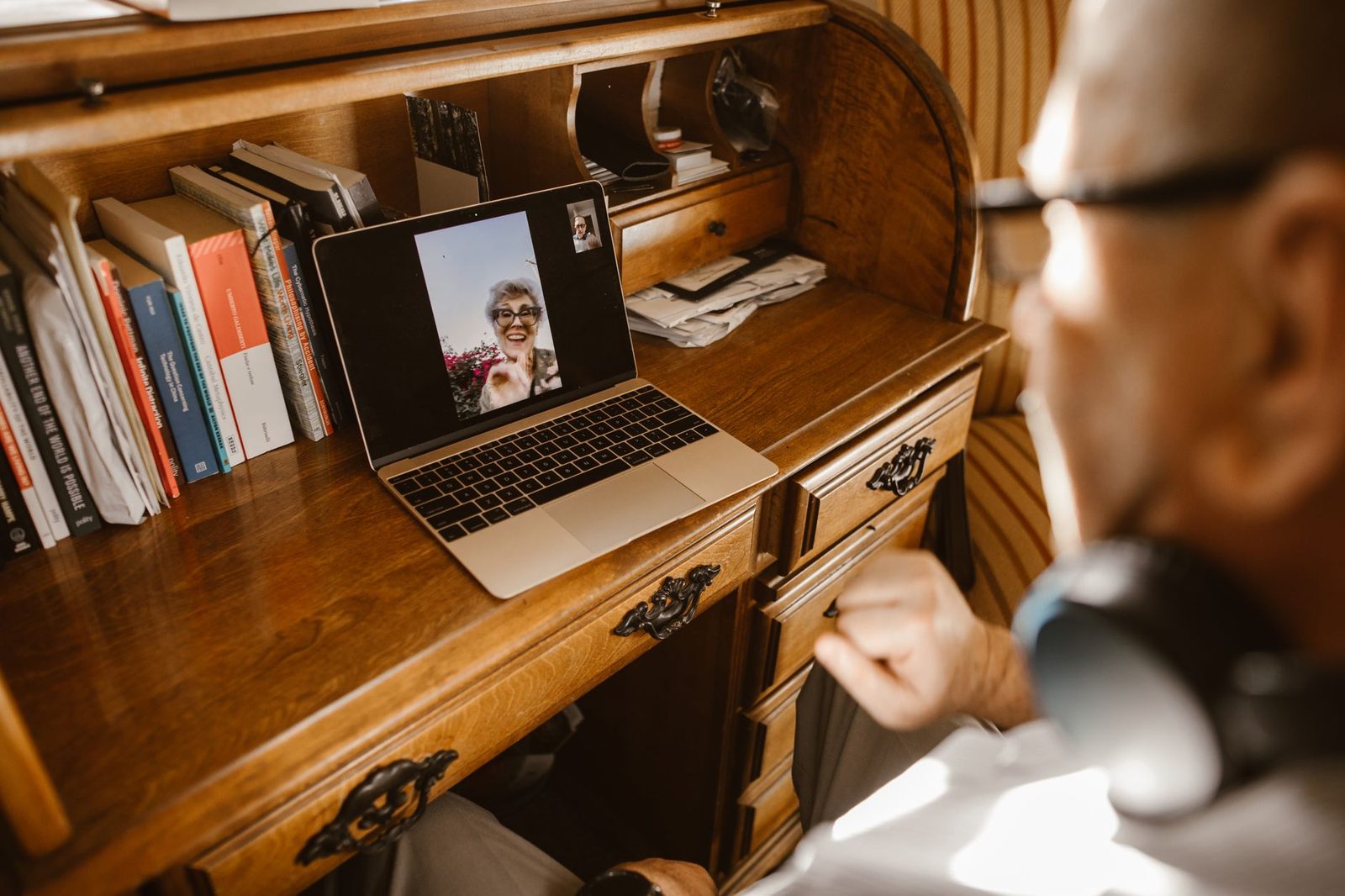
The postman came by at 11 a.m. He said three words. It was the only conversation of the day. For hundreds of thousands of people in France, that scene is no caricature: it's daily life.
The Solitudes barometer from Petits Frères des Pauvres, published regularly since 2017, describes a stubborn reality: several hundred thousand people aged 60 and over are in a state of "social death" — meaning without meaningful contact across the four circles of sociability (family, friends, neighbours, community groups). In response, we offer workshops, clubs, volunteer visits — all of which are precious, and nothing replaces a physical presence.
But there is one tool nobody ever recommends to this age group, because it drags along a sulphurous reputation: random video chat. We've already written here about the first minute of a conversation and about social anxiety in front of the webcam. This article takes an unusual angle: what if chatroulette, properly framed, were a relevant tool for sociability after 60?

What random video chat offers — and what it doesn't
Let's be clear from the outset: a chatroulette replaces neither a friend, nor a family, nor a bowls club. It doesn't create lasting bonds by default, it won't visit you if you fall ill, and it will never know your first name unless you give it.
What it brings is more modest, and paradoxically more accessible:
- Immediate conversation, at any hour. It's 3 a.m., you can't sleep, and waking your daughter is out of the question: somewhere on the planet it's 3 p.m. and someone is awake.
- Zero commitment. No club membership, no subscription fee, no bus ride. You open it, you talk, you close it.
- Practice at speaking. Speech therapists know it: speech, like a muscle, atrophies when it goes unused. Studies on social isolation and cognitive decline — notably those relayed by Inserm on modifiable risk factors for neurocognitive disorders — converge on this point: maintaining regular conversational activity matters.
- Contact beyond your usual circle. Talking with someone from Quebec, Senegal or Belgium renews your stock of anecdotes. It's also, very concretely, an antidote to rumination.
What it doesn't offer, on the other hand: the emotional security of a known bond, and any certainty that the person on the other end means well. That's exactly what follows.
Sort out the equipment before sorting out anything else
Nothing is more discouraging than a failed first attempt: the picture stutters, the sound crackles, the stranger hangs up after four seconds. You conclude that "it's not for me." Usually it's an equipment problem, not a skills problem.
The built-in camera is almost never enough
The webcam of a laptop bought five or six years ago often tops out at mediocre resolution, with a sensor that hates low light — and the homes of people living alone are rarely photo studios. An external full HD webcam perched on the screen changes everything, for a modest budget. It plugs in via USB, is recognised automatically, and you'll see the difference immediately in your own thumbnail.
Sound matters more than picture
Counter-intuitive but proven: on a video call, people forgive an average picture, never tiring sound. Two problems come up again and again:
- People can't hear you well. The screen microphone picks up the whole room, the echo, the fridge.
- You can't hear well. This is common after 60, and it's the leading reason people give up.
A headset with microphone solves both at once: it isolates your ear and places the mic five centimetres from your mouth. If wearing a headset bothers you, a conference speakerphone on the desk is an excellent compromise. And if hearing is genuinely an issue, know that most modern hearing aids connect to a computer via Bluetooth: talk to your audiologist — the French health insurance service (Ameli) also details coverage conditions under the 100 % Santé scheme.
Lighting, the detail that decides everything
A living-room lamp behind you turns you into a black silhouette. The result: the other person sees only a shadow and moves on. Place a light source facing you, never behind. A simple LED desk lamp aimed at the ceiling or a light-coloured wall is enough for a natural look. We go into this in detail in our guide on picture and sound in video calls.

Choosing the right platform: they are not all equal
Since Omegle shut down in November 2023 — its founder Leif K-Brooks announced the end of the service after years of moderation-related litigation — the landscape has fragmented. For a senior audience, three criteria matter far more than the size of the community.
| Criterion | Why it's decisive | What to check before starting |
|---|---|---|
| Active moderation | Reduces exposure to exhibitionist behaviour | A visible report button, mention of human or automated moderation |
| Interest-based filter | Avoids pure zapping and helps you meet compatible profiles | An "interests" field, themed rooms, language filter |
| No heavy sign-up | Fewer personal details handed over | Works without an account, or an account requiring only an email |
Our comparison of Omegle alternatives reviews the active platforms. Above all, remember this principle: favour those offering an interest or language filter. A French-speaking senior who ticks "gardening," "history" or "classical music" cuts the number of unpleasant encounters tenfold, simply by stepping out of the general queue where the crudest behaviour concentrates.
Some platforms also offer a text-only mode: an excellent on-ramp for the first few sessions, before switching to video.
Safety: the six non-negotiable rules
This is the most important part of this article. Isolated people are, sadly, a prime target for scammers, precisely because the need for connection weakens vigilance. The French government portal Cybermalveillance.gouv.fr and the Pharos platform regularly highlight the scale of romance scams and sextortion.
- No identifying details. No surname, no exact town, no name of your bank, your health insurer or your pension fund. "I live in the south-west" is plenty.
- Never money. Ever. No exceptions, no story about a hospital, customs, or a blocked plane ticket. Someone met via webcam who asks for money is a scam in 100 % of cases. That's not an opinion, it's a rule.
- No nudity, no intimate gestures. Sextortion consists of recording and then blackmailing. See our guide on recognising scams and sextortion.
- Don't leave the platform too quickly. An invitation to "continue on WhatsApp" within the first two minutes is warning sign number one: the scammer wants out of the moderated perimeter.
- A physical webcam cover. A small adhesive sliding webcam cover, costing a few euros, guarantees no software will film your living room without your say-so. It's a routine gesture among IT security professionals; it should be routine everywhere.
- Up-to-date antivirus and no software installed at a stranger's request. A serious chatroulette runs in the browser. Nothing to download, ever.
If you've been the victim of blackmail or a scam: pay nothing, keep the screenshots, report it to Pharos (internet-signalement.gouv.fr) and file a complaint. The Info Escroqueries service (0 805 805 817, free) supports victims. Shame protects scammers, not you.
How to start a conversation when you're 65 and the other person is 25
Here's the objection we hear most: "They'll think I'm old, they'll skip to the next person." It's partly justified — and partly wrong.
Justified, because a portion of users are looking for a specific profile and will zap. That's mechanical, it isn't personal, and it happens to twenty-year-olds too.
Wrong, because real-world experience shows the opposite among those who stay: a senior on these platforms is a rarity, and rarity attracts. Plenty of young users, tired of the parade, gladly stop for someone who clearly has more to say than "asl?".
A few concrete levers:
- State the frame in one sentence. "Good evening, I'm 68, I'm here to chat and pass the time, tell me if that works for you." Candour defuses awkwardness and instantly scares off those who aren't there to talk.
- Have a backdrop that speaks for you. A wall of books, a guitar, an aquarium, a workbench: these are free conversation starters. Our article on setting up a video-chat corner explains how to calibrate what you show.
- Ask about location. "Where in the world are you?" It always works, and it opens onto weather, food, family.
- Tell stories, don't interrogate. A thirty-second anecdote — a job you did, a trip, a memorable breakdown — beats ten questions in a row that feel like a cross-examination.
- Count in minutes, not in successes. Out of twenty people, fifteen will skip. Three will exchange two sentences. Two will give you a genuine moment. That's the normal ratio, even for regulars.

Setting boundaries so the tool stays a tool
When loneliness is real, the risk isn't using chatroulette too little: it's spending six hours straight on it and coming away emptier than before. We've devoted a whole article to the mental fatigue of marathon sessions and another to compulsive "next"-ing. Two simple safeguards:
A duration decided in advance. Thirty to forty-five minutes, two or three times a week. A kitchen timer placed next to the screen does the job perfectly — it cuts the loop with no room for argument.
A slot in the day, not the whole day. Random video chat works well as a complement: after the morning walk, before the evening news. It works badly as the sole substitute for a social life.
And if the goal really is to escape isolation, pair the digital experience with a local step. Petits Frères des Pauvres, Monalisa (the national mobilisation against isolation among older people), municipal social action centres (CCAS) and France Services offer visits, digital workshops and free support. A printed introductory computing guide for seniors, sitting next to the computer, is also far more useful than a video tutorial you have to pause every ten seconds.
Key takeaways
Random video chat wasn't designed for seniors, and it probably never will be. That doesn't mean it's off-limits to them — it means approaching it equipped, informed and with clear boundaries.
- Decent sound and front-facing lighting are worth more than any conversation tip.
- Platforms with an interest or language filter radically transform the experience.
- No personal details, no money, no software installed at a stranger's request.
- A duration set in advance, and a local anchor alongside it.
Loneliness is not a technical inevitability. It's fought on several fronts at once — and a window open onto the world, at 10 p.m. in a silent living room, is one of them.